

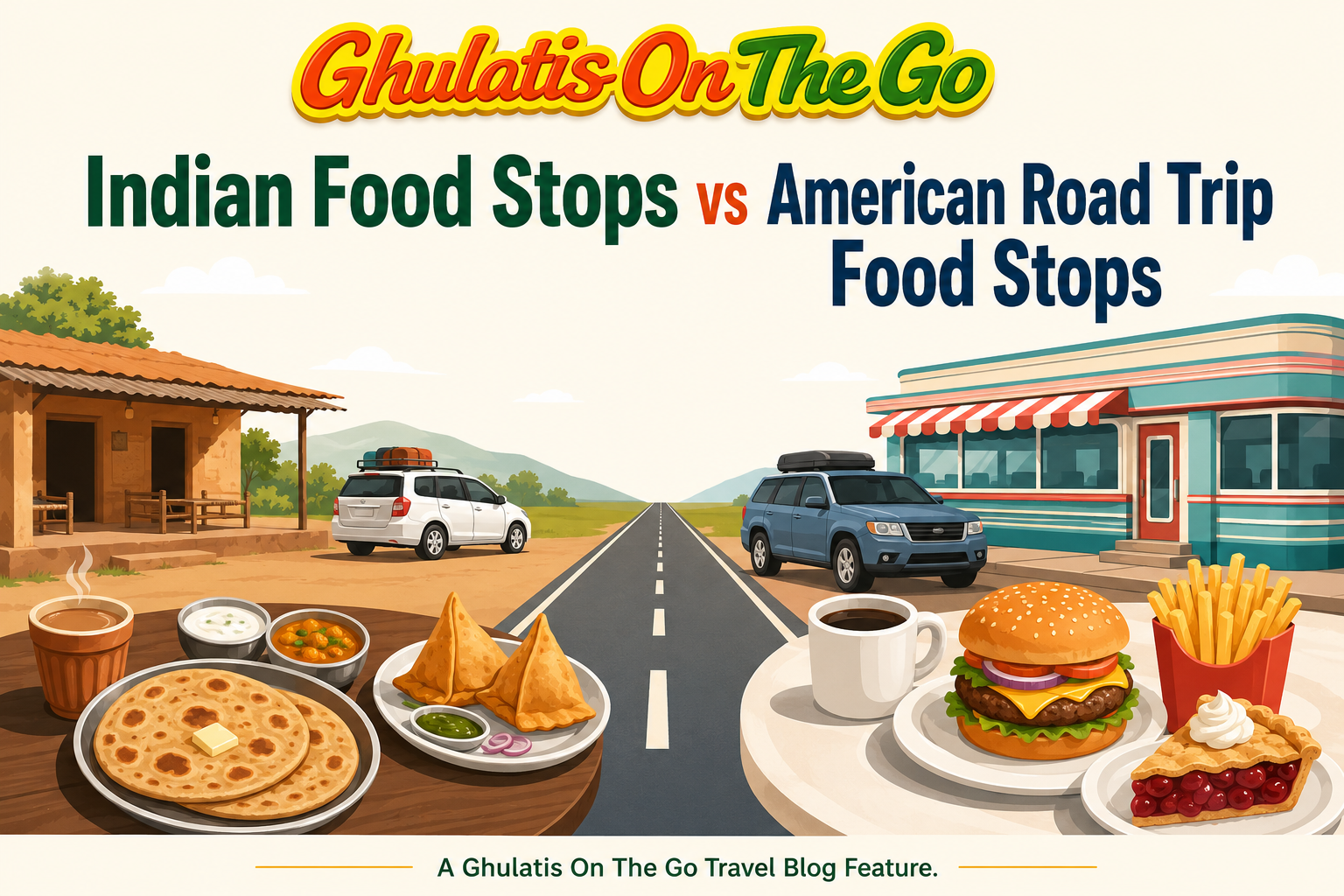
A good road trip is never just about the miles. It is about the stops in between: the first cup of tea before sunrise, the snack that keeps everyone happy, the meal that turns a long drive into a family memory, and the place where everyone stretches, refuels, resets, and gets ready for the next part of the journey.
In India, that food stop might be a dhaba along a highway, with hot chai, parathas, dal, rotis, rice, regional snacks, and the sounds of travelers coming and going. In the United States, it might be a diner, a truck stop, a convenience store, a fast-food exit, or a quiet rest area where families grab coffee, sandwiches, burgers, fries, snacks, and drinks before getting back on the road.
Both countries have huge road-travel cultures, but the food-stop experience feels very different. That difference is what makes the comparison fun.
Why food stops matter on road trips. Food stops are not just about eating. They are part of road safety, comfort, planning, and culture.
In the United States, driving remains central to travel. AAA projected that 45 million Americans would travel at least 50 miles from home for Memorial Day 2026, with 39.1 million traveling by car. AAA also said driving made up 87% of Memorial Day travel that year. More broadly, the Bureau of Transportation Statistics has reported that 87% of daily trips in the United States take place in personal vehicles.
India also has a massive road-travel system. India’s Ministry of Road Transport and Highways stated in its 2025 year-end review that India has the world’s second-largest road network, with National Highways spanning 1,46,560 km. That means highway food stops are not just random places to eat; they are part of the rhythm of travel for families, truck drivers, commuters, tourists, and long-distance travelers.
The Indian highway food stop: the dhaba experience. The classic Indian road-trip food stop is the dhaba. Dhabas are often described as rustic, no-frills roadside eateries found near highways, petrol stations, or town outskirts. Whetstone Magazine traces dhaba culture especially to Punjab and Haryana, where these stops served truck drivers and long-distance travelers.
The charm of a dhaba is that it often feels connected to the place around it. The food may change by region, the language on the sign may change, and the atmosphere may change from one highway to another. A North Indian highway stop may bring to mind parathas, dal, roti, chai, lassi, and tandoori-style dishes. In other regions, the road-food experience may include local rice dishes, dosas, idlis, vadas, poha, pakoras, regional thalis, or whatever the local food culture does best.
A dhaba meal can feel informal and practical. Travelers stop because they are hungry, but also because they need a break. A family might order tea first, then something hot and filling. The food is often served quickly, and the setting is usually casual. The experience is less about polished dining and more about warmth, energy, and comfort.
India is also modernizing highway stops. NHAI announced plans to develop wayside amenities every 30–50 km along current and upcoming highways and expressways, including fuel stations, EV charging, food courts, retail shops, ATMs, toilets with shower facilities, children’s play areas, clinics, and village haats for local handicrafts. A later Humsafar Policy document described planned wayside amenities with fuel stations, restaurants, dhabas, convenience stores, clean toilets, drinking water, first-aid or medical rooms, child-care rooms, parking, and areas for local artisans.
That means India’s road-food scene is becoming a mix of old and new: the traditional dhaba, the modern highway food court, the fuel-stop restaurant, and the planned family-friendly rest stop.
The American road trip food stop: exits, diners, rest areas, and convenience stores. In the United States, the road-trip food stop is shaped by the interstate system, exit signs, rest areas, diners, fast-food restaurants, truck stops, and convenience stores.
American highways often tell travelers what services are coming next. The Federal Highway Administration’s Manual on Uniform Traffic Control Devices says general service signs can show services such as Food, Gas, Lodging, Camping, Phone, Hospital, 24-Hour Pharmacy, or Tourist Information. That is why American road trips often revolve around the next exit: fuel here, food here, coffee here, hotel here.
Rest areas also play an important role, although they are not always full-service food stops. Caltrans describes safety roadside rest areas as places where travelers can stop, stretch, nap, use restrooms, get water, check maps, switch drivers, check vehicles, and exercise pets. On many interstate routes, commercial activity inside rest areas is limited; FHWA has noted that federal law and regulation prohibit over-the-counter sales of merchandise in Interstate rest areas, with limited exceptions such as vending machines and tourism-related information.
That helps explain a key difference: in the U.S., a “rest area” and a “food stop” are often separate things. A rest area may be for bathrooms and stretching, while a meal may require exiting the highway for a restaurant, diner, gas station, or convenience store.
Convenience stores are a huge part of American road travel. NACS reported 151,975 convenience stores in the United States as of Dec. 31, 2025, and 122,620 of them sold motor fuels. NACS also estimated that convenience stores sell 80% of the fuel purchased by consumers in the United States. That makes the American fuel stop a food stop too: coffee, fountain drinks, packaged snacks, hot food, sandwiches, candy, chips, and quick meals are all part of the experience.
And then there is the diner. The American diner has become one of the most recognizable images of road travel: coffee mugs, pancakes, burgers, fries, pie, booths, counter seating, and a menu that can satisfy a tired family quickly. Not every American road trip includes a classic diner, but the idea of the diner remains deeply tied to the image of the open road.
What makes Indian food stops different? Indian road-trip food stops often feel more regional and more connected to local cooking. A dhaba is not just a place to eat; it can feel like a local snapshot. The flavors, cooking style, spices, breads, rice dishes, sweets, and drinks can change depending on the state or highway.
The experience can also feel more communal. Food is often shared at the table. A plate of pakoras, a basket of rotis, a bowl of dal, or a pot of chai can become part of the group experience. Even a short stop can feel lively.
Another difference is that Indian highway eating can be very tea-centered. Chai is not just a beverage; it is a road-trip reset button. For many travelers, stopping for chai is as important as stopping for fuel.
What makes American food stops different? American road-trip food stops often prioritize speed, predictability, and convenience. A family on a long drive may choose a place because it is close to the exit, has clean restrooms, accepts cards, has familiar food, and lets everyone get back on the road quickly.
The U.S. system is also heavily built around signs and exits. Drivers look for “Food,” “Gas,” and “Lodging” signs, then choose from what is available near the ramp. That makes the American road-food stop more structured in many places.
American food stops also offer a wide range of choices. A single highway exit might have fast food, a gas station, a coffee shop, a diner, a supermarket, or a sit-down restaurant. At larger truck stops and travel centers, food, fuel, restrooms, showers, parking, and travel supplies may all be in one place.
Similar goal, different feeling. The biggest similarity is simple: both countries use food stops to make the journey easier.
In India, the stop may feel like a flavorful pause in the middle of a busy highway journey. In America, the stop may feel like a practical reset between long stretches of road. One may be centered around chai and parathas; the other may be centered around coffee and burgers. One may feel like a dhaba courtyard; the other may feel like a diner booth or a fuel-station table.
But in both places, the goal is the same: eat something, use the restroom, stretch your legs, check on the vehicle, let the kids reset, and get back on the road with a better mood.
Food safety matters in both countries. No matter where the road trip happens, food safety matters.
For outdoor eating and packed road-trip food, the FDA recommends keeping cold food at 40°F or below in a cooler with ice or frozen gel packs, keeping coolers closed as much as possible, and separating beverages from perishable foods when possible. The FDA also says picnic food should not remain in the “danger zone” between 40°F and 140°F for more than two hours, or more than one hour if outdoor temperatures are above 90°F.
For international travelers, the CDC advises avoiding lukewarm food, choosing hot food that is served hot, being careful with raw foods, and using safer drinking-water habits in places where water quality may be uncertain.
That advice applies to both sides of this comparison. A great food stop should be enjoyable, but travelers should still pay attention to cleanliness, temperature, water safety, and how food is stored or served.
Which food stop is better? That depends on what kind of traveler you are.
If you love local flavor, spontaneous stops, regional dishes, and the feeling that the food is part of the place, Indian dhabas and highway eateries are hard to beat. They can turn a long drive into a flavorful cultural experience.
If you love predictable stops, clear highway signs, quick access to fuel, coffee, restrooms, snacks, and familiar food, American road-trip stops are incredibly practical. They are designed around convenience and speed.
The best answer is not that one is better than the other. They are different because the roads, food cultures, travel habits, and infrastructure are different.
India’s highway food stops often feel like part of the journey’s personality. America’s road-trip food stops often feel like part of the journey’s planning. One feeds the memory. The other keeps the schedule moving. The best road trips need both.
Final thoughts. Road-trip food is more than a meal. It is the smell of chai at a roadside dhaba. It is the first sip of gas-station coffee before sunrise. It is kids choosing snacks. It is parents checking the route. It is a plate of parathas, a basket of fries, a slice of pie, a hot samosa, a burger, a cup of tea, or a simple sandwich eaten halfway to somewhere meaningful.
Indian food stops and American road-trip food stops may look different, taste different, and feel different, but they both prove the same thing: the journey is always better when there is good food along the way.