

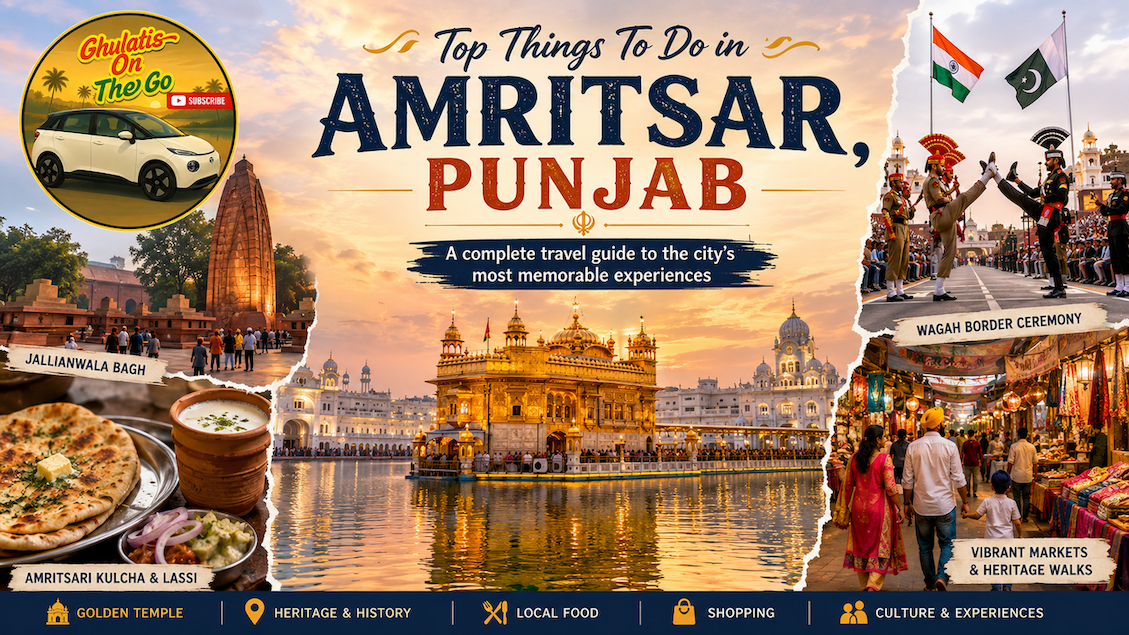
Amritsar: A City That Welcomes You With Faith, Food, History, and Heart
Amritsar is not the kind of city you simply pass through. It is the kind of city that asks you to slow down.
You may arrive by road, train, or air. You may come for a spiritual visit, a family trip, a food journey, a heritage walk, a border ceremony, or a return to ancestral memories. But once you step into Amritsar, the city begins to speak in many voices. There is the sound of kirtan near Sri Harmandir Sahib. There is the quiet weight of Jallianwala Bagh. There is the emotional storytelling inside the Partition Museum. There is the patriotic rhythm of the Attari-Wagah ceremony. There is the smell of tandoor, kulcha, chole, lassi, jalebi, and chai drifting from busy lanes. There are shopkeepers, pilgrims, students, travelers, families, guides, rickshaw drivers, and food vendors all moving through the same living story.
Official tourism sources describe Amritsar as a spiritual and cultural capital of Punjab, with the Golden Temple at its core and a wider identity shaped by narrow lanes, bustling bazaars, and spiritual sanctuaries. That is what makes Amritsar special. It is not only one monument, one meal, or one photo spot. It is a layered city where the sacred, the historic, and the everyday sit close together.
This guide is written as a long, humanized blog for travelers who want more than a checklist. It is based on factual sources and keeps clear boundaries between confirmed information and travel reflection.
1. Visit Sri Harmandir Sahib, the Golden Temple
No visit to Amritsar feels complete without time at Sri Harmandir Sahib, commonly called the Golden Temple. Incredible India describes the shrine as a symbol of spirituality, unity, service, equality, and community, standing beside the waters of the Amrit Sarovar. The source also notes that the temple’s dome is adorned with about 400 kilograms of pure gold leaf.
The Golden Temple is more than a famous landmark. It is one of those rare places where architecture, devotion, music, water, light, and human service come together. Visitors do not only look at the shrine; they experience the atmosphere around it. People walk barefoot on the marble. Families sit quietly beside the sarovar. Volunteers serve, clean, guide, and help. The experience can be deeply moving because the place is not designed around spectacle alone. It is built around faith and seva.
The District Amritsar administration also describes the Golden Temple as one of the most sacred pilgrim spots for Sikhs and notes that it is built on a 67-foot square marble platform as a two-storied structure.
For a traveler, the best way to visit is not to rush. Walk slowly around the parikrama. Notice the reflection of the sanctum in the water. Watch how people from different backgrounds sit together. Listen more than you speak. Amritsar’s most famous place is also its most humbling.
2. Sit for Langar and Experience the Spirit of Seva
The Golden Temple experience is incomplete without understanding langar, the community kitchen tradition rooted in Sikh values. Incredible India connects the Golden Temple with values such as equality, service, and community.
Langar is not simply a meal for visitors. It is a living expression of equality. People sit together regardless of background. Volunteers prepare, serve, clean, and organize the flow of thousands of visitors. The most powerful part of the experience is not only the food itself, but the feeling that everyone is welcome.
For many travelers, this becomes one of the most memorable parts of Amritsar. The city may have famous restaurants and street food, but langar carries a different meaning. It is food as service. Food as humility. Food as community.
3. Walk Through Jallianwala Bagh With Respect
A short distance from the Golden Temple area is Jallianwala Bagh, one of the most important historical sites in Amritsar. The District Amritsar administration describes the site as a memorial to Indians who were killed or wounded on April 13, 1919, when British troops under General Dyer fired on a peaceful public meeting. The official district page says the memorial commemorates 2,000 Indians who were killed or wounded.
Jallianwala Bagh is not a place to treat casually. It asks for silence. It asks for attention. It asks visitors to remember that tourism is not always about enjoyment; sometimes it is about memory and responsibility.
The preserved space, the memorial, and the historical references make this one of the essential stops in Amritsar. Families often visit after the Golden Temple because the two sites are close, but emotionally they are very different. One offers spiritual peace. The other carries the pain of colonial violence and India’s struggle for freedom.
A thoughtful visit to Amritsar should include both.
4. Visit the Partition Museum at Town Hall
The Partition Museum is another deeply important stop for anyone trying to understand Amritsar and Punjab’s modern history. The museum’s official website states that the Amritsar museum is housed in the historic Town Hall building, located in the renovated Heritage Plaza, about a 5- to 7-minute walk from the Golden Temple.
The museum’s official “Visit” page describes it as the world’s only museum built on Partition and says it is a people’s museum built through donations and stories. It also recommends allowing at least an hour for a visit, especially for those interested in history.
This is one of the most human places in Amritsar because Partition was not only a political event. It was a human rupture. It affected families, homes, memories, languages, friendships, and identities. In a city so close to the India-Pakistan border, the Partition Museum gives context to the emotional geography of Punjab.
Travelers who visit only monuments may miss this deeper story. The museum helps visitors understand why Amritsar is not just a holy city or a food city. It is also a city marked by migration, loss, rebuilding, and resilience.
5. Walk Heritage Street Between Town Hall, Jallianwala Bagh, and the Golden Temple
Heritage Street is one of the most practical and atmospheric ways to experience central Amritsar on foot. The India Cine Hub location description says the Heritage Street stretch begins at the old Town Hall building, which now houses the Partition Museum, continues toward Jallianwala Bagh, and leads up to the Golden Temple. It describes the stretch as roughly one kilometer and notes its redesigned heritage-style appearance.
This walk brings together several of Amritsar’s most meaningful experiences in one route: the Partition Museum, Jallianwala Bagh, the old-city approach, shopping lanes, food stops, and the Golden Temple entrance area. It is not just a road. It is a transition from civic history to national memory to spiritual center.
For a human travel story, this walk matters because it shows how Amritsar is lived. You see pilgrims, tourists, local families, shopkeepers, photographers, guides, and street vendors. You see people buying souvenirs, stopping for tea, helping elders, asking for directions, and taking family photos. The city feels alive here.
6. Experience the Attari-Wagah Border Ceremony
The Attari-Wagah border ceremony is one of the most recognized experiences near Amritsar. The District Amritsar administration describes Wagah as the international border between India and Pakistan and says the daily evening Beating Retreat ceremony is the highlight, with soldiers from both countries marching in drill before the flags are lowered.
This experience is energetic, patriotic, and very different from the calm atmosphere of the Golden Temple. Crowds gather, flags wave, chants rise, and the ceremony becomes a public expression of national feeling. It is often included in Amritsar itineraries because it adds a borderland dimension to the city’s story.
The important thing is to understand what you are seeing. Amritsar is not far from the border, and the border is not an abstract line here. It is part of the region’s history, movement, identity, and memory. A visit to the ceremony can be exciting, but it is also connected to the larger story of Partition and Punjab’s divided geography.
7. Explore Gobindgarh Fort
Gobindgarh Fort is one of Amritsar’s major heritage sites. The District Amritsar administration describes it as a symbol of Punjab and an iconic protector of Amritsar, located in the center of the holy city along the Grand Trunk Road. The official district page says the fort spans 43 acres and has a history of more than 300 years, connected with the Bhangi Misl, Maharaja Ranjit Singh, the East India Company, and the Indian Army.
The fort’s own official site describes it as a living museum that tells stories of Maharaja Ranjit Singh, Sikh warriors, and Punjab’s heritage.
Gobindgarh Fort is a good stop for travelers who want Amritsar beyond the Golden Temple area. It gives the city a martial and political history, showing Punjab through forts, power, protection, and changing rule. It also offers cultural programming and visitor experiences, with the fort’s official timing page listing the fort hours as 10 AM to 10 PM and mentioning shows and museums within the complex.
Because timings and ticket details can change, travelers should check the official fort website before visiting.
8. Visit Maharaja Ranjit Singh Museum
The District Amritsar administration lists Maharaja Ranjit Singh Museum among the city’s tourist places and notes that it is about 1.5 km from Amritsar Junction and 4 km from the Golden Temple.
Maharaja Ranjit Singh is central to Punjab’s history, and Amritsar’s connection to his legacy is also visible at the Golden Temple, where official sources note that Maharaja Ranjit Singh had the upper half of the shrine covered with gold leaf.
For visitors interested in Sikh and Punjabi history, this museum can help connect the spiritual and political story of Punjab. It adds depth to the Amritsar itinerary because the city is not only about individual attractions; it is part of a larger historical landscape shaped by power, faith, empire, resistance, and memory.
9. Visit Durgiana Temple
Durgiana Temple is another important religious site in Amritsar. The official Durgiana Temple website says Shri Durgiana Temple is situated in the middle of a sarovar and is an important Hindu religious place in Amritsar, where devotees come to worship and pay obeisance. It also states that a bridge provides approach to the temple and gives the tank’s dimensions as 541 feet by 432 feet and 20 feet deep, with government records dating the tank to the 16th century.
The District Amritsar tourist places page also includes Durgiana Temple and describes it as built in the third decade of the 20th century, reflecting traditional Hindu temple architecture.
Durgiana Temple gives travelers another view of Amritsar’s religious life. While the Golden Temple is the city’s most famous sacred site, Amritsar’s spiritual geography includes multiple traditions and communities. Visiting Durgiana Temple helps travelers understand the city as a place where different forms of devotion exist close to one another.
10. Visit Bhagwan Valmiki Tirath Sthal, Also Known as Ram Tirath
Ram Tirath, also known as Bhagwan Valmiki Tirath Sthal, is located west of Amritsar on Chogawan Road. The District Amritsar administration says the site is located 12 km west of Amritsar and dates back to the period of the Ramayana, associated with Rishi Valmiki’s hermitage. The official page also mentions an ancient tank, temples, a hut marking the site where Mata Sita gave birth to Luv and Kush, Rishi Valmiki’s hut, and a stepped well associated with Mata Sita.
Incredible India also describes Ram Tirath Temple as Bhagwan Valmiki Tirath Sthal and says the present monument includes an 8-foot-tall, 800-kg gold-plated idol of Sage Valmiki.
This is a meaningful stop for travelers interested in religious history, mythology, and the wider sacred geography of Amritsar. It is not always at the top of short tourist lists, but for many devotees and culturally curious visitors, it adds another important chapter to the city’s story.
11. Spend Time at Sadda Pind for Punjabi Village Culture
Sadda Pind is a cultural attraction in Amritsar focused on traditional rural Punjab. Its official website describes it as a Punjabi Culture Living Museum established to preserve the art, culture, and history of traditional rural Punjab. The site says it is a 12-acre living museum and a scientific reconstruction of a 19th-century agrarian settlement.
The official day-package page says Sadda Pind offers visitors experiences of Punjabi art, culture, heritage, live performances, interactive exhibits, and a recreated village setting.
This kind of experience is valuable because many visitors come to Punjab wanting to understand village life, not just city monuments. For families, children, NRIs, and first-time visitors, Sadda Pind can offer a structured introduction to rural traditions, crafts, food, music, and performance.
Punjab’s culture is not only something displayed in museums. It is also lived in kitchens, fields, songs, fairs, homes, and family gatherings. Sadda Pind packages part of that world into a visitor-friendly setting.
12. Eat Amritsari Kulcha, Chole, Lassi, and Local Punjabi Food
Amritsar is one of India’s great food cities in the practical, everyday sense: people travel there to eat. Official tourism sources for Amritsar emphasize the city’s vibrant energy, bazaars, and cultural identity, and Punjabi cuisine is naturally part of that travel experience.
A food journey in Amritsar is not only about fine dining. It is about the tandoor, the steel plate, the clay cup, the butter, the pickle, the onions, the chole, the steam, and the small shop where generations of customers have eaten. Amritsari kulcha is one of the most famous local food experiences, often paired with chole and lassi.
Food in Amritsar feels personal because it is tied to hospitality. The server may insist you eat more. The tea may be stronger than expected. The kulcha may arrive crisp, hot, and rich. The lassi may feel like a meal by itself. These small moments become part of the travel memory.
A practical note: popular food places can be crowded, especially near major tourist zones. Go with patience, check hygiene, and respect local queues and seating systems.
13. Shop for Phulkari, Punjabi Juttis, Suits, Shawls, and Local Goods
Amritsar’s markets are part of the city’s travel experience. Official tourism descriptions of Amritsar mention bustling bazaars and narrow lanes as part of the city’s atmosphere.
Shopping in Amritsar can include phulkari embroidery, Punjabi suits, juttis, shawls, religious souvenirs, dry fruits, snacks, and local crafts. The market areas near the Golden Temple and Heritage Street are especially active because visitors often combine shrine visits, food stops, and shopping in the same outing.
The human part of shopping in Amritsar is the conversation. A shopkeeper may ask where you are from. A family may compare colors for a wedding. A traveler may buy something small to take home as a memory. Markets are not only commercial spaces; they are social spaces.
As with any busy tourist market, travelers should compare prices, check quality, keep belongings secure, and be respectful while bargaining.
14. Take a Slow Old-City Walk
One of the best things to do in Amritsar is simply to walk, especially around the old city and heritage areas. The Heritage Street route connecting Town Hall, Jallianwala Bagh, and the Golden Temple offers a concentrated experience of the city’s visitor core.
A slow walk lets you notice what a vehicle ride cannot. You see the old facades, the food counters, the religious shops, the families moving together, the elders resting, the children pointing at lights, the pilgrims walking barefoot, and the constant rhythm of a city that receives visitors every day.
This is where Amritsar becomes more than a list. A city’s spirit often appears between its official landmarks. It appears in the way people give directions, in the smell of chai, in a shop sign, in a prayer sound, in a narrow turn, in the glow of evening lights.
Travelers should dress respectfully, especially near religious places, and remain alert in crowded lanes.
15. Visit Gurudwara Baba Deep Singh Ji, Also Known as Shahidan Sahib
Incredible India describes Gurudwara Baba Deep Singh Ji as Shahidan Sahib, a shrine commemorating the courage of Baba Deep Singh Ji. The source connects the site to events in 1757, when Afghan forces threatened the Golden Temple and Baba Deep Singh Ji rallied with other Sikhs to defend their faith.
For visitors interested in Sikh history, this gurdwara adds a story of sacrifice and valor to the Amritsar itinerary. The Golden Temple may be the city’s spiritual center, but Amritsar’s Sikh heritage is not contained in one site alone. Places like Gurudwara Baba Deep Singh Ji help travelers understand the depth of devotion and resistance associated with the region.
As with all gurdwaras, visitors should cover their heads, remove shoes, dress respectfully, and maintain quiet dignity.
16. See Khalsa College From the Outside or Include It in a Heritage Route
The District Amritsar official website’s front page lists Khalsa College Amritsar among highlighted tourist-place images.
Khalsa College is widely recognized for its striking architecture and presence in the city’s educational and cultural landscape. Travelers who enjoy architecture and photography often include it in wider Amritsar routes, although access rules can vary because it is an educational institution.
The respectful approach is simple: admire the architecture, follow any posted rules, avoid disturbing students or staff, and do not assume public access to private or institutional spaces.
17. Visit Pul Kanjari for a Wider Heritage Excursion
The District Amritsar photo gallery lists Pul Kanjari among the district’s featured heritage and tourist images.
Pul Kanjari is often included by heritage-minded travelers who want to explore beyond the standard Golden Temple-Jallianwala Bagh-Wagah route. It is associated with Punjab’s historic landscape and can be combined with wider border-area exploration depending on time and access.
Because visitor facilities and access conditions can change, travelers should verify current local details before planning this stop.
18. Add a Food-and-History Day Instead of Rushing Everything
A common mistake in Amritsar is trying to finish the city too quickly. The most popular circuit—Golden Temple, Jallianwala Bagh, Partition Museum, local food, and Wagah ceremony—can fill a full day on its own. The Partition Museum itself recommends at least an hour for visitors especially interested in history.
A slower day allows the city to feel more human. You can begin with the Golden Temple, walk to Jallianwala Bagh, visit the Partition Museum, pause for lunch, shop lightly, rest, then leave for the Attari-Wagah ceremony later in the day. This rhythm respects both the emotional weight of the sites and the practical reality of crowds.
Amritsar is not a checklist city. It rewards travelers who allow space between experiences.
19. Understand Amritsar Through Its Past
The past of Amritsar is visible everywhere. Sri Harmandir Sahib is connected with Sikh faith and service. Jallianwala Bagh is tied to the tragedy of 1919. The Partition Museum preserves stories from 1947. Gobindgarh Fort reflects more than 300 years of history connected with Sikh rule, colonial power, and the Indian Army.
This is why Amritsar feels emotionally dense. Its landmarks are not decorative. They carry memory.
A visitor who understands this will experience the city differently. The Golden Temple will not be only a beautiful building. Jallianwala Bagh will not be only a garden. The Partition Museum will not be only a museum. Gobindgarh Fort will not be only a fort. Each place becomes part of a larger Punjabi and Indian story.
20. Experience Amritsar’s Present: A Living Travel City
The present-day Amritsar experience is shaped by pilgrims, tourists, families, NRIs, students, food lovers, heritage walkers, and local workers. Official tourism sources describe Amritsar as a city of history, devotion, narrow lanes, bazaars, and spiritual sanctuaries.
The city’s present is also shaped by how people move through it. The old city can be crowded. The most famous areas can be busy. Popular food places may require patience. The Attari-Wagah ceremony draws crowds. Heritage Street can feel festive and full.
But that busyness is also part of Amritsar’s character. This is a city that receives people constantly. Its tourism is not separate from local life. Visitors and residents share roads, markets, food counters, religious spaces, and public memories.
The best traveler in Amritsar is not the fastest one. It is the one who moves with awareness.
21. Think About the Future of Amritsar Tourism
The future of Amritsar tourism will likely continue to be shaped by its strongest factual assets: the Golden Temple, Jallianwala Bagh, the Partition Museum, the Attari-Wagah border ceremony, heritage sites, religious tourism, food culture, and Punjabi cultural experiences. These are not assumptions; they are the established attractions and themes documented by official and institutional sources.
What cannot be stated as fact are unsupported predictions about exact visitor numbers, future rankings, or guaranteed development outcomes. What can be said is that Amritsar already has a rare combination of spiritual, historical, cultural, and culinary tourism assets. Its future visitor experience will depend on how well the city protects sacred spaces, maintains heritage areas, manages crowds, improves cleanliness and transport, and supports local businesses without losing the warmth that makes Amritsar memorable.
The city’s future should not only be measured in more visitors. It should be measured in better experiences, deeper understanding, safer movement, cleaner streets, respectful tourism, and stronger local livelihoods.
Suggested Amritsar Itinerary
One-Day Amritsar Plan
Start early at Sri Harmandir Sahib so you can experience the atmosphere with more calm. Spend time walking around the sarovar and, if possible, sit for langar. After that, walk toward Jallianwala Bagh and give the memorial the quiet attention it deserves. Continue to the Partition Museum at Town Hall, which is officially located within walking distance of the Golden Temple and Jallianwala Bagh. Later, enjoy a local lunch, rest briefly, and plan the evening around the Attari-Wagah border ceremony.
Two-Day Amritsar Plan
Use the first day for the Golden Temple, Jallianwala Bagh, Partition Museum, Heritage Street, local food, and shopping. Use the second day for Gobindgarh Fort, Durgiana Temple, Ram Tirath, Sadda Pind, or a slower food-and-market walk depending on your interests.
Three-Day Amritsar Plan
A third day gives the city room to breathe. You can revisit the Golden Temple at a different time of day, spend more time with food and markets, add Gurudwara Baba Deep Singh Ji, explore Gobindgarh Fort more fully, or include wider heritage stops. This slower pace is especially helpful for families, older travelers, and visitors who want to absorb the city instead of racing through it.
Practical Travel Notes
Religious places in Amritsar require respectful behavior. At gurdwaras, visitors should cover their heads, remove shoes, and dress modestly. At memorial sites such as Jallianwala Bagh, the tone should be respectful because the site commemorates people killed or wounded in 1919.
Museum and fort timings can change, so travelers should verify current hours before visiting. The Partition Museum’s official website lists the Amritsar museum timing as 10:00 AM to 6:00 PM, Tuesday to Sunday, closed on Mondays. Gobindgarh Fort’s official timing page lists fort hours as 10 AM to 10 PM.
Crowds are common around the Golden Temple, Heritage Street, Jallianwala Bagh, food lanes, and the Attari-Wagah ceremony. Build extra time into your plan and avoid treating Amritsar like a city that can be fully understood in a hurry.
Conclusion: Amritsar Is Not Just Seen, It Is Felt
The top things to do in Amritsar are not only activities. They are encounters.
At the Golden Temple, you encounter devotion and service. At langar, you encounter equality in action. At Jallianwala Bagh, you encounter the grief of history. At the Partition Museum, you encounter human stories of loss and survival. At Attari-Wagah, you encounter the emotion of a border. At Gobindgarh Fort, you encounter the legacy of power and protection. At Durgiana Temple and Ram Tirath, you encounter other sacred layers of the city. At Sadda Pind, markets, and food streets, you encounter the living culture of Punjab.
That is why Amritsar remains unforgettable. It does not offer only one kind of travel. It offers prayer, memory, taste, color, courage, grief, hospitality, and belonging.
A traveler may come to Amritsar for the Golden Temple, but many leave with much more: the sound of shabad, the sight of golden light on water, the silence of a memorial, the stories of Partition, the energy of the border, the comfort of hot kulcha, and the feeling that Punjab’s heart is still beating strongly in this city.