

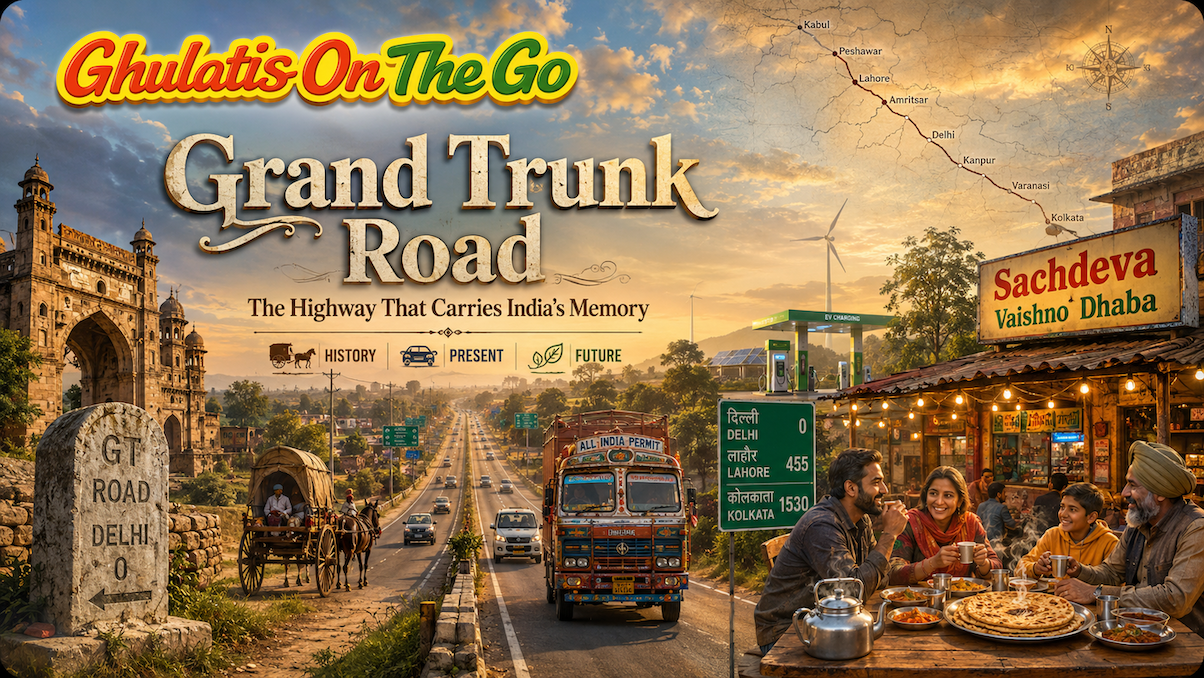
Where the Road Begins in Memory
Some roads are built only to move traffic. GT Road was built, rebuilt, expanded, renamed, and remembered because it moved civilization.
The Grand Trunk Road, commonly called GT Road, is one of those rare highways that feels older than the cities around it. It has carried soldiers, traders, pilgrims, farmers, truck drivers, families, and dreamers. It has seen empires rise and fall. It has watched horse carts turn into trucks, sarais turn into hotels, and roadside tea stalls turn into famous dhabas.
In India, many people know GT Road not from history books, but from real life. It is the road of long drives, early morning chai, truck headlights, parathas with white butter, temple visits, family road trips, and the feeling that somewhere ahead there will always be another town, another stop, another story.
Historically, the Grand Trunk Road is considered one of the oldest and most significant road routes in India, with roots going back to at least 300 BCE. Britannica describes it as an ancient road connected with the Mauryan period and later expanded during medieval times, linking regions across present day Afghanistan, Pakistan, India, and Bangladesh.
A Road Older Than Most Kingdoms
The story of GT Road does not begin with asphalt, toll plazas, or highway signs. It begins with the ancient route known as Uttarapatha, meaning the northern road. This route connected the eastern parts of the Indian subcontinent with the northwest and beyond. Long before modern borders, this was a path of movement. People carried spices, textiles, horses, grain, ideas, languages, religious teachings, and news along this route.
During the Mauryan period, the importance of this road grew. A large empire needed communication. It needed officials to travel, armies to move, merchants to trade, and messages to reach distant regions. The road became part of a larger imperial vision, helping connect places that would otherwise remain isolated.
It is difficult to say that one single ruler built GT Road from nothing, because the road evolved over centuries. A more accurate way to understand it is this: the ancient route existed first, the Mauryas strengthened and used it, later rulers improved it, Sher Shah Suri gave it a major organized expansion, and the British rebuilt large portions for colonial administration and commerce.
That layered history is what makes GT Road special. It is not the work of one generation. It is the work of many Indias.
Sher Shah Suri and the Great Road
When people talk about GT Road, one name always comes up: Sher Shah Suri.
Sher Shah Suri ruled in North India in the 16th century, and although his reign was short, his impact on roads, administration, and communication was lasting. He understood that a strong road network was not just about travel. It was about power, governance, trade, security, and connection.
He is widely remembered for rebuilding and expanding the old route into what became known as Sadak e Azam, meaning the great road. The road connected major centers across northern India and beyond. Along the way, sarais were built for travelers. Trees were planted for shade. Wells helped people and animals survive long journeys. Milestones and rest points made the road more organized.
This was a huge achievement for its time. A road like this changed the rhythm of travel. It gave merchants more confidence. It gave officials better reach. It gave travelers safer pauses. It helped towns along the route grow into markets, military points, and cultural meeting places.
Sher Shah Suri did not create the idea of the route, but he gave it structure and scale. He turned an ancient path into a more purposeful highway.
The British Era and a New Name
The name Grand Trunk Road became more common during British rule. The British saw the road as a strategic and commercial artery. They needed reliable movement between Calcutta, Delhi, Punjab, and the northwest. Roads were essential for military control, postal movement, trade, and administration.
During the 19th century, large parts of the route were rebuilt and improved. The old road became more formalized, metalled, and maintained for heavier use. The British era did not erase the older identity of the road, but it did give it the name by which much of the world now recognizes it.
This is one of the fascinating things about GT Road. Every age renamed it in its own way. Uttarapatha. Sadak e Azam. Badshahi Sadak. Grand Trunk Road. GT Road. Each name belongs to a different political and cultural moment, but the road underneath remains part of the same long story.
India’s official UNESCO Tentative List recognizes the heritage value of sites along Uttarapatha, Badshahi Sadak, Sadak e Azam, and Grand Trunk Road. India submitted this cultural route to UNESCO’s Tentative List in 2015, showing that GT Road is not just transport infrastructure but also a heritage corridor.
GT Road Today
Today, the old GT Road is not one simple road with one number from beginning to end. Modern highways have been renumbered, widened, diverted, and upgraded. In India, major parts of the historic route now align with highways such as NH 19 and NH 44. The old Delhi to Kolkata road, once commonly associated with NH 2, is now divided into modern numbered sections, with the Delhi to Agra stretch associated with NH 44 and the Agra to Kolkata stretch associated with NH 19.
But people still call it GT Road.
That tells you something important. Government numbers may change, but public memory is stubborn. Ask many drivers, truckers, or roadside shopkeepers, and GT Road is still GT Road. It is a name that carries habit, emotion, and recognition.
The present standing of GT Road is a mix of history and modern pressure. In some stretches, it is a wide, fast, multi lane highway. In others, it passes through crowded towns, industrial belts, religious centers, old markets, and dense roadside development. It carries long distance freight, local commuters, buses, pilgrims, tourists, and families heading from one city to another.
This is not a quiet heritage road frozen in time. It is alive, busy, noisy, and constantly changing.
Food Faith and Familiar Stops
One of the most beautiful things about GT Road is that it is not only a route on a map. It is a food trail.
Highways create their own cuisine. Drivers need hot food. Families need clean restrooms. Pilgrims need vegetarian meals. Truckers need filling plates at odd hours. Over time, dhabas became part of the GT Road identity.
The dhaba is one of India’s great travel institutions. It is practical, emotional, and deeply democratic. You can find a businessman, a truck driver, a student, a family, and a group of bikers all eating under the same roof. The food is usually simple, hot, and generous. Dal, roti, paratha, sabzi, chai, curd, pickle, and lassi become part of the journey.
On the Delhi to Punjab side, Murthal became famous for parathas and highway dining. Amrik Sukhdev in Murthal, for example, says it was founded in 1956 mainly to serve truck drivers and now describes itself as a major landmark on GT Road.
That transformation mirrors the story of the road itself. What began as a practical stop for drivers became a destination for families and road trippers. Today, some people drive to Murthal just to eat, not because they are going anywhere farther.
Sachdeva Vaishno Dhaba and the Comfort of Highway Food
A road like GT Road is remembered through places like Sachdeva Vaishno Dhaba.
Located on G.T. Road at Pipli, Kurukshetra, Sachdeva Vaishno Dhaba is listed as a North Indian vegetarian only restaurant, serving breakfast, lunch, dinner, takeaway, and home delivery.
For many travelers, a Vaishno dhaba means comfort. It usually suggests vegetarian food, familiar flavors, and a style of cooking that feels safe for families, pilgrims, and people who prefer simple North Indian meals. On a long highway journey, that matters. You do not always want fancy food. Sometimes you want hot roti, dal, paneer, rice, pickle, and tea that tastes like it belongs to the road.
Pipli and Kurukshetra are important because this stretch of GT Road is not just about eating. It is also about faith and history. Kurukshetra is tied to the Mahabharata tradition and is a major spiritual and cultural stop. A traveler passing through this region can experience something very GT Road in spirit: a meal at a roadside dhaba, a visit to a sacred place, and then the continuation of the journey.
That is the magic of this highway. It does not separate daily life from history. They sit side by side.
Other Stops Worth Slowing Down For
GT Road is filled with places where a traveler should slow down, not just to rest, but to understand the road.
Amritsar is one of the most powerful stops in the larger GT Road imagination. The Golden Temple, the old city lanes, Punjabi food, and the emotional pull of the Wagah border region make this area unforgettable. Even when travelers are focused on the highway, Amritsar invites them to pause.
Ludhiana and Jalandhar bring another side of the road: industry, commerce, migration, and Punjabi enterprise. These are cities of factories, markets, colleges, families abroad, and constant movement. GT Road helped make such places more connected to the rest of North India.
Panipat is another historic stop. It is remembered for its battles, but it is also a textile and industrial city. Standing near Panipat, one can feel how GT Road has always been linked with power. Armies moved through this belt. Traders moved through it. Today, trucks and commuters do.
Delhi, of course, is more than a stop. It is a major hinge in the route. For centuries, whoever controlled Delhi cared about the roads leading in and out of it. GT Road helped connect Delhi to Punjab on one side and to Uttar Pradesh, Bihar, Bengal, and beyond on the other.
Agra brings in Mughal memory. The Taj Mahal may be the main attraction, but Agra’s place on the old road network also reminds us that empire, architecture, and movement were connected.
Kanpur, Prayagraj, Varanasi, Sasaram, Dhanbad, Asansol, and Kolkata each add their own flavor to the eastern stretch. Varanasi brings spirituality and timelessness. Sasaram brings the memory of Sher Shah Suri himself. Dhanbad and Asansol bring coal, industry, and labor. Kolkata brings the eastern gateway, colonial history, trade, literature, and the Hooghly.
A drive on GT Road is not just a drive across distance. It is a drive across layers of India.
The Future of GT Road
The future of GT Road will likely be shaped by three needs: speed, safety, and heritage.
Speed is already visible. Wider highways, bypasses, flyovers, better pavement, logistics parks, and improved freight movement are part of modern India’s road building vision. The Grand Trunk Road Improvement Project was also linked to India’s National Highway Development Program, showing how this historic corridor has been part of modern highway upgrading efforts.
Safety will matter even more. Historic highways often pass through dense settlements, old markets, and mixed traffic zones. Trucks, cars, motorcycles, pedestrians, tractors, buses, and animals may all share the same corridor in different stretches. The future GT Road cannot only be faster. It has to be safer. Better service lanes, pedestrian crossings, lighting, emergency care, speed management, and driver rest facilities will be important.
The third need is heritage, and this may be the most overlooked. GT Road deserves better storytelling. Imagine highway signs that tell travelers they are driving on a road with roots going back more than two thousand years. Imagine clean heritage stops near old kos minars, sarai sites, battlefields, temples, gurudwaras, mosques, markets, and historic towns. Imagine QR codes at rest areas explaining the road’s ancient, medieval, colonial, and modern life.
Modernization should not erase memory. The best future for GT Road would combine better roads with better respect for the past.
There is also a practical future for travelers. NHAI’s wayside amenity vision includes rest and refreshment facilities such as restaurants, food courts, dhabas, fuel stations, minor repair shops, medical clinics, clean restrooms, driver dormitories, EV charging stations, and parking for cars, buses, and trucks.
That matters because the next generation of GT Road travel may include more electric vehicles, better rest stops, cleaner facilities, digital payments, safer parking, and more organized food courts. But hopefully, there will still be room for the old style dhaba, the steel glass of chai, and the paratha that makes a journey feel complete.
Why GT Road Still Matters
GT Road matters because it proves that roads are not just engineering projects. They are social spaces.
A road can shape where cities grow. It can decide which markets become powerful. It can help religions spread, armies march, families migrate, and businesses survive. It can also create memories so ordinary that people forget they are historical.
A family stopping for breakfast at Murthal is part of the story. A truck driver resting near Kurukshetra is part of the story. A pilgrim traveling toward Amritsar or Varanasi is part of the story. A student taking a bus to Delhi is part of the story. A shopkeeper whose business depends on passing vehicles is part of the story.
GT Road has never belonged only to kings and empires. It belongs to everyone who has used it.
That is why the road still feels human. Its greatness is not just in its age or length. Its greatness is in the way it continues to serve life. It has changed names, surfaces, rulers, borders, and highway numbers. Yet it remains one of the most recognizable road memories in South Asia.
The Grand Trunk Road is history you can still drive on. It is a museum without walls. It is a food trail, trade route, pilgrimage path, freight corridor, and family road trip all at once.
And somewhere along the way, perhaps near Pipli at Sachdeva Vaishno Dhaba, or near Murthal over a plate of parathas, the traveler realizes something simple: GT Road is not only about where you are going. It is about everyone who has passed before you.