

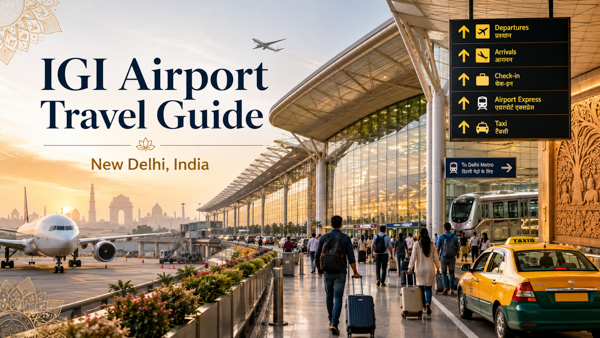
If you have flown anywhere in or out of North India, chances are you have passed through Indira Gandhi International Airport, known to almost everyone simply as IGI or Delhi Airport. It is not a small operation. In the financial year running from April 2024 to March 2025, IGI handled just over 79 million passengers, including about 21.6 million international travelers, making it the busiest airport in India for the sixteenth year running and, according to the aviation consultancy OAG, the ninth busiest airport on the planet as of 2025.
The airport began life as RAF Palam, built by the British during the Second World War as a staging ground for Allied flights across Asia. After independence, the Indian Air Force ran it before management passed to the Airports Authority of India, and then, in May 1986, the newly built international terminal was inaugurated and the whole complex was renamed after former Prime Minister Indira Gandhi. Today it sits on a genuinely enormous 5,106 acre site in Palam, in South Delhi, close to the Haryana border, and it is run under a concession from the Airports Authority of India (AAI) by Delhi International Airport Limited, a consortium led by the GMR Group that now holds a 74 percent stake, with AAI holding the remaining 26 percent.
None of that history matters much when you are standing in an arrivals hall trying to find your driver, though, so let us get into the parts that actually help you get through the place.
The Three Terminals, and Which One Is Actually Yours
IGI has three working passenger terminals plus a general aviation terminal for private jets and a separate cargo complex, and knowing which one you need before you leave home will save you a genuinely stressful last minute taxi detour.
Terminal 1, in the northeast corner of the complex, handles domestic flights operated by the budget carriers IndiGo and SpiceJet. It has just come through a major transformation. The old terminal was actually four separate buildings, 1A through 1D, built at different points from the 1980s onward, and 1A and 1B have since been closed and are slated for demolition. In 2025, after an extensive rebuild, Terminal 1 reopened as a single integrated building with a striking pier shaped like the neck of a guitar, and it is now designed to handle up to 40 million passengers a year.
Terminal 2, in the southwest corner next to Terminal 3, has had an unusual life. It opened in 1986 as Delhi's international terminal, lost that role to Terminal 3 in 2010, spent years operating just three months annually for Hajj flights, and was later used by GoAir and select IndiGo domestic flights while Terminal 1 was being rebuilt. It went through its own renovation and reopened for flight operations in October 2025, and it now handles a portion of Delhi's domestic traffic.
Terminal 3 is the one most travelers picture when they think of Delhi Airport, and it carries essentially the entire international operation. It is a genuinely large building, a two tier structure with arrivals on the lower floor and departures on the upper floor, and it was the world's eighth largest passenger terminal when it opened in 2010, built in time for that year's Commonwealth Games. It has 168 check in counters, 78 aerobridges across 48 contact stands, 95 immigration counters, 18 X ray screening areas, and 14 baggage carousels. International flights depart from gates 1 through 26, while domestic flights, since Terminal 3 also hosts Air India, Air India Express, and select IndiGo and SpiceJet domestic services, use gates 27 through 62. If you look up while you are walking through, keep an eye out for the sculptures near the immigration counters, including a depiction of the Hindu solar deity Surya and a wall of hasta mudras, hand gestures, extending over the arrivals area. It is one of the more thoughtful design touches in an airport this size.
The practical takeaway is simple: your airline assignment can and does shift as these terminals get renovated, so always confirm your terminal on your actual ticket rather than relying on what you remember from a previous trip.
Getting To and From the Airport
The fastest way into central Delhi from Terminal 3 or Terminal 2 is the Airport Express Line of the Delhi Metro, which runs from the IGI Airport metro station to New Delhi metro station, where it connects to the Yellow Line and the New Delhi Railway Station, in about 20 minutes. The line continues the other direction to Dwarka Sector 21, which connects to the Blue Line, Bijwasan railway station, and the Dwarka bus terminus, and trains run roughly every 10 minutes. Terminal 1 has its own stop, on the Magenta Line, a short distance from the terminal building.
If you would rather take a bus, air conditioned low floor buses run by the Delhi Transport Corporation connect the airport to the wider city on a regular schedule, and two new Inter State Bus Terminals, one near Aerocity close to Terminal 1 and one by Dwarka Sector 21, are under construction to handle longer distance routes into Haryana and Punjab.
Metered taxis and app based cabs are available at every terminal, and prepaid taxi counters in the arrivals halls are the simplest option if you would rather not negotiate a fare, typically running somewhere between ₹400 and ₹600 into central Delhi depending on distance and traffic.
By road, the airport sits on two major eight lane expressways. The Delhi Gurgaon Expressway, part of NH 48, is the older and busier ground level route running through Gurgaon. The newer Dwarka Expressway is an elevated road that runs to the west of Gurgaon and tends to move faster during peak traffic.
What Domestic Travelers Actually Go Through
Here is something worth clearing up before we get to customs and immigration, because it trips people up: those two processes exist only because a passenger is crossing an international border. If you are flying between two Indian cities, you will never see a customs officer or an immigration counter at any point in your journey. What you will go through instead is check in, whether at a counter, a kiosk, or entirely on your phone, a baggage drop if you have checked luggage, security screening, and boarding.
Delhi Airport has also rolled out DigiYatra across all three terminals, a facial recognition system that lets domestic travelers register their identity documents once through an app, using Aadhaar based verification and a selfie, and then move through terminal entry, security, and the boarding gate just by having their face scanned rather than repeatedly showing a physical boarding pass and ID. It is optional, free, and genuinely useful during the festival travel rush around Diwali or Chhath Puja, when domestic terminals get extremely busy.
Customs and Immigration: What International Travelers Go Through
This part is exclusive to Terminal 3 and to anyone crossing into or out of India by air.
On arrival, foreign nationals fill out a disembarkation form, usually handed out on board or available near the international arrival pier before immigration. Anyone visiting India for the first time also needs to register their biometric details, a facial scan and fingerprints, at kiosks placed before the immigration counters. From there, foreign passport holders proceed to the dedicated counter for their category and present their passport, boarding pass, visa, and completed disembarkation form for verification.
Indian citizens and Overseas Citizen of India cardholders go through separate counters, and an increasing number now skip the counter entirely through the Fast Track Immigration, Trusted Traveller Programme, generally shortened to FTI TTP. Delhi was the first airport in the country to launch it, in June 2024, and Terminal 3 has eight automated gates dedicated to the programme, four for arrivals and four for departures. Registration happens online in advance through the government portal, requires a passport valid for at least six months, and is free of charge. Once enrolled, you simply scan your passport and boarding pass at the first gate, then your face at the second, and the whole process takes well under a minute rather than the 20 to 30 minutes a manual queue can run during busy periods. The programme is currently open to Indian nationals and OCI cardholders, with foreign travelers expected to be added in a later phase.
Once you are through immigration, check the flight information screens for your baggage carousel. International arrivals are commonly assigned to belts in the 7 to 12 range, though this varies by flight, so it is worth glancing at the screen rather than assuming. After collecting your bags, you will choose a customs channel. The green channel is for travelers with nothing dutiable to declare, and the red channel is for anyone carrying goods above the personal allowance, high value electronics, or anything for commercial use. Under the Baggage Rules, 2026, which took effect on 1 February 2026, resident travelers get a duty free allowance of ₹75,000, a notable increase over the previous rules. There is no penalty for declaring too cautiously, but understating what you are carrying can mean prosecution and confiscation, so when you are genuinely unsure, take the red channel. Indian Customs also offers a free app called ATITHI that lets travelers submit their declaration digitally before landing. It will not guarantee faster clearance, but customs officers generally view a proactive, accurate declaration favorably, and it cuts down on paperwork at the counter itself.
The Airlines That Fly Into Delhi
Around 80 airlines serve IGI in total. It functions as a hub or focus city for Air India, Alliance Air, IndiGo, and SpiceJet, and as an operating base for Air India Express as well.
On the international side, the long haul full service names will be familiar: Emirates, Qatar Airways, Etihad Airways, Lufthansa, British Airways, Air France, KLM, Swiss International Air Lines, Turkish Airlines, Singapore Airlines, Cathay Pacific, Japan Airlines, All Nippon Airways, Korean Air, United Airlines out of Newark, American Airlines out of New York's JFK, and Air Canada flying to Toronto with a seasonal Montreal service. Regional and Gulf carriers such as flydubai, Saudia, Kuwait Airways, Oman Air, Gulf Air, and Air Arabia add further options, alongside a strong Southeast and Central Asian presence from Thai Airways, Thai AirAsia X, VietJet Air, Vietnam Airlines, Malaysia Airlines, and several Central Asian operators connecting Delhi to cities like Almaty, Tashkent, Baku, and Dushanbe. Among Indian carriers, Air India, IndiGo, SpiceJet, and Air India Express all operate international routes of their own out of Delhi.
Domestically, IndiGo, Air India, Air India Express, SpiceJet, Akasa Air, and Alliance Air, which concentrates on smaller regional routes under the government's UDAN scheme, cover the bulk of the network, linking Delhi to destinations across the country from Amritsar in the north to Port Blair in the Andaman Islands.
Cargo is its own significant operation here too. FedEx Express and Quikjet Airlines both use Delhi as a hub, and carriers including UPS Airlines, Cathay Cargo, Qatar Cargo, Emirates SkyCargo, and Blue Dart Aviation move freight through the airport's dedicated cargo complex, which in 2022 became the first in India to run entirely on hydro power and solar energy.
Peak Times: When Delhi's Skies Get Busiest
There are two windows worth knowing if you are planning to meet an international flight.
The first is the early morning bank. Most long haul flights from Europe and North America depart their origin cities in the evening, roughly 8 PM to 11 PM local time, and given typical flight durations and the time difference, they land in Delhi somewhere between 8 AM and 11 AM the following day. If you are waiting on a flight from London, Frankfurt, Paris, or New York, expect a morning wait, and expect immigration and baggage claim to be busy, since several widebodies often land within the same hour.
The second is the late night to predawn window. Flights from East and Southeast Asia and much of the Gulf tend to land between 11 PM and 4 AM, since many of those routes are short enough that airlines schedule them as overnight departures from the origin city. This is also when the airport itself changes character. The metro stops running for the night, and a number of restaurants switch to a reduced late night menu.
Civil aviation officials have also been working to spread out the roughly 1,200 flights IGI handles on an average day, since congestion at security and immigration during the morning and evening rush has been a persistent complaint from travelers. Proposals under discussion would cap peak hour movements at somewhere around 14 for Terminal 3, 11 for Terminal 2, and 8 for Terminal 1, though the exact figures were still being finalized at the time of writing.
The practical upshot is to arrive at least 3 hours before an international departure, and closer to 3.5 hours during Delhi's winter fog season, which reliably disrupts flights between December and February even at an airport equipped with the advanced landing systems IGI has. If you are meeting someone during either peak window described above, build extra patience into your plan, since immigration and baggage claim both slow down considerably when multiple widebody flights land close together.
Parking, for Domestic and International Flights
Terminal 3 has the airport's flagship parking facility, a multi level car park directly opposite the terminal, built with India's first automated parking guidance system and room for about 4,300 cars. Level 2 of that structure is set aside as a Park and Fly long stay zone for travelers heading away for several days. The unified rate for private cars runs roughly ₹80 for the first 30 minutes, ₹180 for up to 2 hours, and around ₹90 for each additional hour, with a daily cap somewhere near ₹1,180, though I would genuinely recommend checking the current tariff board or newdelhiairport.in before you go. I found at least one figure quoted directly by the airport's own social media account that did not match the published rate card, so treat any number here, mine included, as a starting point rather than gospel. Valet parking is also available at Terminal 3, generally priced around ₹500 for 2 hours.
Terminals 1 and 2 have their own, simpler car parks close to arrivals and departures. They tend to be cheaper than the Terminal 3 facility and are paid at the exit rather than through the centralized payment stations T3 uses. None of the Terminal 1 or 2 lots are covered, so if you are leaving a car in Delhi's summer heat or monsoon rain for any length of time, that is worth factoring in.
Every terminal has dedicated kerbside pickup and drop lanes with a short free window, often just a handful of minutes, before automated cameras start charging. Overstay in one of these lanes and you risk both a parking fee and a wheel clamp or tow, so if you expect any real wait for an arriving passenger, it is genuinely less stressful to park properly in the multi level structure or the Terminal 1 or 2 lots and walk in rather than circle the pickup lane.
SIM Cards, Currency Exchange, and Lounges for International Arrivals
Airtel and Jio counters sit just past customs in the Terminal 3 arrivals hall, before the exit. Bring your passport, a copy of your visa, and one photograph, budget somewhere around ₹500 to ₹700, and expect activation to take a couple of hours, though you will usually be given a QR code to complete the process yourself once the SIM goes live. It is worth buying from the official counters rather than the touts who sometimes work the arrivals kerb outside.
Currency exchange counters are available throughout the arrivals area, but airport rates typically run about 1.5 to 2 percent worse than what you would get in the city. Exchanging a small amount, enough to cover a taxi and a meal, and switching to an ATM once you are settled in Delhi tends to work out better financially.
Both Terminal 3 and the domestic terminals have paid lounges, and a number of airlines and premium credit cards offer complimentary or discounted access as a benefit. If lounge access matters to your trip, it is worth checking your specific airline programme or card benefits ahead of time, since the offerings and partner lounges do change fairly often.
Picking Someone Up: The Process for Domestic and International Arrivals
For domestic arrivals at Terminal 1 or Terminal 2, meeting someone is genuinely simple. There is no security barrier between the arrivals hall and the exit the way there is for international flights, so most people wait in the arrivals hall itself or just outside it, watching the flight information screens for the baggage belt number. If you are driving, use the short term parking rather than idling in the pickup lane, since the free window there is brief.
International arrivals at Terminal 3 work a little differently, because everyone coming from abroad has to clear immigration and customs before reaching the public arrivals hall, and that entire process is closed to visitors. Most people simply wait in the general arrivals hall or just outside it. If you want to get a little closer, Delhi Airport sells a Visitor Entry Pass for ₹100 per person, valid for 3 hours from the time it is issued, which gets you into a dedicated Meet and Greet area inside the Terminal 3 arrivals section, near Pillar 10 in the arrivals forecourt. You will need a valid photo ID, children under 3 are admitted free, and the pass does not allow laptops or bags inside, so travel light if you plan to use one. It is also worth knowing that these visitor passes have been temporarily suspended in the past for security reasons, so it makes sense to confirm they are currently being issued before you build a pickup plan around one.
If you would rather not manage any of this yourself, particularly if you are meeting someone elderly, traveling with young children, or simply exhausted after a long flight, several operators offer a meet and assist service. A representative waits at the aerobridge itself, sometimes with an electric cart, escorts the arriving passenger through immigration and baggage claim, and either hands them off to you in the arrivals hall or arranges a private transfer straight into the city.
Landing Late: What Delhi Looks Like After Midnight
A meaningful share of Delhi's international arrivals land between 11 PM and 4 AM, and the airport genuinely changes personality once the sun goes down. The Airport Express Metro stops running for the night, so a hotel shuttle or a cab becomes the only realistic way into the city. Several restaurants inside the terminal switch to a limited late night menu, and almost nothing in the surrounding area stays open once you step outside.
If you are arriving on an overnight flight, buying a local SIM before you leave the arrivals hall, rather than hunting for WiFi later, will make ordering a cab and finding your hotel considerably easier. A cluster of hotels in the Aerocity district, a short drive from Terminal 3, keep 24 hour reception and room service specifically for passengers landing at odd hours, and some run their own airport shuttles. If you have a connecting flight the next morning, it is often genuinely worth booking a few hours in one of these rather than trying to wait it out in the terminal itself.
Where the Airport Is Headed Next
IGI is not finished growing. Terminal 1's recent renovation and Terminal 2's 2025 reopening were both just one phase of a much longer plan. Further out, the airport's master plan calls for three entirely new terminals, numbered 4, 5, and 6, which would eventually take over all of the airport's international traffic and let Terminal 3 handle domestic flights only. Once that is complete, Delhi International Airport Limited expects total capacity to reach around 100 million passengers a year. There is also a planned automated people mover, a driverless train intended to link Terminal 1, Terminal 2 and Terminal 3, Aerocity, and the cargo complex, which is now being funded directly by DIAL after an earlier attempt to bring in an outside contractor drew limited interest. Construction is expected to take about 30 months once it begins.
Quick Answers to Common Questions
How early should I arrive? About 2 hours before a domestic flight and 3 hours before an international one, with extra buffer during winter fog season or if you are checking bags during a festival rush.
Is the airport open all night? Yes, IGI operates around the clock, though shops and food options thin out considerably between roughly midnight and 5 AM.
How do I know which terminal is mine? Your ticket or boarding pass will state it directly. As a general rule, IndiGo and SpiceJet domestic flights mostly use Terminal 1, a portion of domestic flights use Terminal 2, and Terminal 3 covers every international flight plus the full service domestic carriers, but always confirm on your actual ticket since assignments do shift as terminals get renovated.
Can someone without a ticket come inside to see me off or meet me? Not past security. For international arrivals specifically, a paid Visitor Entry Pass gets people into a designated meeting area within Terminal 3's arrivals section, but it does not grant access to departures or any security controlled zone.
Is there WiFi? Yes, complimentary WiFi is available across all three terminals.
What is the biggest thing to plan around in winter? Fog. Dense fog regularly disrupts both flights and the roads leading into the airport between December and February, so build in extra time on both ends of your journey during those months.
A Last Word
Whether you are catching an early IndiGo hop to Mumbai or landing bleary eyed off a long haul flight from New York, Delhi's airport is built to move a genuinely enormous number of people every single day. Once you know which terminal you actually need, how the pickup and parking lanes work, and roughly when the busy windows fall, it stops feeling like the maze it can seem like on a first visit.