

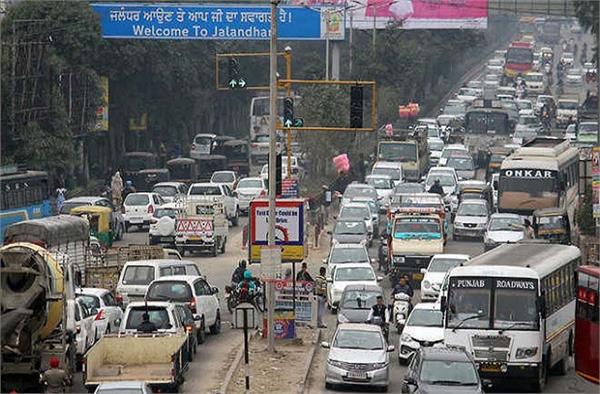
A city built around movement
Jalandhar is not a sleepy city sitting quietly away from the main routes of Punjab. It is a city shaped by roads. For decades, its importance has come from location: the city sits on important regional corridors linking Amritsar, Ludhiana, Pathankot, Hoshiarpur, Nakodar, Kapurthala, Nurmahal, and other parts of Doaba and Punjab. The Jalandhar Master Plan describes the city’s road network as “ring and radial,” with roads radiating outward from the city core and several major roads converging toward the centre. It also notes that four National Highways and several important roads pass through the city.
That is the blessing and the burden of Jalandhar. A road that brings customers to a market also brings through-traffic. A junction that helps people reach a hospital, school, bus stand, shop, court, or railway station also becomes a bottleneck. A city that grew around business, education, migration, small industry, local markets, and NRI-linked travel slowly began to carry more traffic than many of its older roads were designed to handle.
The Jalandhar Master Plan put the problem plainly. It said the existing transportation network had not kept pace with ever-rising travel demand within and outside the city, and that roads had lost their functional character and were carrying traffic beyond their service capacity. It also described traffic and transportation in Jalandhar as chaotic for a major portion of the day, causing road users to suffer enormously.
Those are not casual complaints. They are planning-language warnings. They show that Jalandhar’s traffic problem did not appear suddenly in one election season, one festive season, or one road repair cycle. The problem has been growing for years.
The past: when Jalandhar’s roads began carrying more than they could hold
To understand Jalandhar’s present traffic, the past must be taken seriously. The older structure of the city was not built for today’s number of cars, two-wheelers, auto-rickshaws, delivery vehicles, school vans, buses, goods carriers, roadside vendors, and parked vehicles. The city’s main roads became shared spaces for every kind of movement: fast vehicles, slow vehicles, pedestrians, vendors, shoppers, shopkeepers, buses, rickshaws, and informal parking.
The Master Plan identified old GT Road as one of the most congested stretches because of mixed land use, mixed traffic, and on-street parking. When residents park along a road, when shops spill activity toward the street, and when vehicles of different speeds compete for the same carriageway, the effective road width shrinks. The plan directly connects this shrinking road space with traffic jams.
Jalandhar’s vehicle growth was also documented early. The number of registered vehicles rose from 18,532 in 1995 to 38,020 in 2007, according to District Transport Officer figures included in the Master Plan. The same section noted that vehicle ownership was likely to accelerate and that strategies were needed to reduce dependence on personal vehicles by offering better public transport options.
The composition of traffic also mattered. In 2007, fast-moving vehicles accounted for 37,505 vehicles, while slow-moving vehicles accounted for 20,963, for a total of 58,468 in the traffic-composition table. The plan noted that the presence of a large number of slow-moving vehicles created conflicts, delays, and pollution, and that mixing traffic reduced vehicle speeds and added to congestion.
That is an important human detail. Traffic is not only about how many vehicles exist; it is about how different kinds of vehicles interact. A cyclist, a cycle-rickshaw, a scooter, a car, a bus, a truck, and a pedestrian do not move in the same way. When all of them are forced into a limited road space, the road becomes more than crowded—it becomes unpredictable.
Public transport: the missing pressure valve
A strong public transport system can act like a pressure valve for a growing city. In Jalandhar, that pressure valve has not been strong enough. The Master Plan recorded that public transport had operated earlier through Punjab Roadways and later shifted to the Municipal Corporation, but Municipal Corporation services were withdrawn, leaving much of the system handled by private owners. It also said a pilot Jalandhar City Bus Service was operating on four routes, with possible expansion if successful.
The same planning document identified a key structural issue: all routes originated and terminated at the main bus terminal, increasing congestion in central areas. Because public transport services were inefficient and unorganised, residents relied heavily on personalised vehicles, cycle-rickshaws, and auto-rickshaws, which increased congestion, accidents, parking pressure, and pollution.
This explains why Jalandhar’s traffic became a daily lifestyle problem. When reliable public transport is limited, families depend more on private two-wheelers and cars. Students, workers, shopkeepers, patients, and daily commuters all enter the road network separately instead of being carried efficiently through organized transit. The result is visible at chowks, markets, school zones, hospitals, and narrow commercial lanes.
The measured warning signs: heavy traffic volumes and peak-hour pressure
Traffic surveys included in the Master Plan gave numbers to what residents were already experiencing. The RITES study covered a corridor of about 5 km passing through six important intersections: BMC Chowk, Guru Nanak Mission Chowk, Ambedkar Chowk, Football Chowk, Kapurthala Chowk, and HMV Chowk. These are not minor points. They are part of Jalandhar’s everyday movement map.
The mid-block survey found average daily traffic volumes ranging from 21,000 to 73,000 vehicles on surveyed roads. Mahavir Marg toward Ambedkar Chowk at Guru Nanak Mission Chowk recorded the highest volume mentioned: 73,483 vehicles, with peak-hour traffic up to 7,383 vehicles. The plan noted that peak-hour traffic ranged from 9.0% to 12.1%, comparable to congested urban metropolitan conditions, and called the situation alarming when considered against right-of-way and future growth.
That means Jalandhar’s traffic challenge was not merely emotional or anecdotal. It was measured. The city had stretches where road volumes were already behaving like bigger-city congestion, even though the road environment still carried the habits and limitations of an older urban form.
The present: where daily life meets the traffic jam
Today’s Jalandhar traffic story is not only about vehicles. It is about people losing time. It is about parents stuck near schools, shopkeepers watching customers hesitate to enter crowded markets, patients worrying about ambulance delays, workers calculating extra travel time, and drivers circling for parking because roads have become parking lots.
Local reporting has repeatedly pointed to encroachments and unauthorized parking as major contributors. In 2018, The Tribune reported that encroachments in market areas were eating away road space and causing frequent jams. It mentioned areas such as Kishanpura, Ajit Chowk to Alaska Chowk, Rainak Bazaar, Tikkian Wala Chowk, Phagwara Gate, Mai Hiran Gate, and Jyoti Chowk, where pedestrians and commuters faced constant inconvenience.
That same pattern has continued in newer reporting. In 2023, The Tribune reported that festive rush, slow road repairs, road closures, and alternative-route diversions created chaos on Jalandhar roads. The report identified Johal Market Road, Cool Road, Model Town Road near Latifpura, Guru Nanak Mission Chowk to Nakodar Chowk, Jyoti Chowk, Rama Mandi Chowk, Bhagat Singh Chowk, Ravidass Chowk, and the area near Dolphin Hotel as affected traffic spots. It also reported commuter concerns that even ambulances sometimes got stuck in long jams.
In 2025, Jag Bani described Jalandhar’s traffic as “out of control,” reporting that several points in the city caused daily trouble for thousands of people. The report highlighted old GT Road around Bhagwan Valmiki Chowk, Plaza Chowk, and Jail Chowk; Gulab Devi Road’s canal bridge; Phagwara Gate; Babu Jagjivan Ram Chowk; and the area near Adarsh Nagar Gurdwara and Basti Bawa Khel canal bridge. It also stated that earlier enforcement against kiosks, carts, and roadside encroachments had loosened and that some cleared spots had again filled with more roadside activity.
This is the human face of traffic: not one jam, but the repetition of jams. Not one bad day, but a pattern. Not only one main road, but a network of pressure points where road space, parking, vendors, market traffic, local movement, and regional traffic collide.
Encroachments, parking, and the shrinking road
One of the most persistent themes in Jalandhar’s traffic story is the shrinking of usable road space. A road may look wide on paper, but if both sides are occupied by parked vehicles, shop extensions, carts, informal loading, pedestrians pushed off sidewalks, or waiting auto-rickshaws, the actual usable road becomes much narrower.
The Tribune’s 2018 report described shopkeepers adding counters outside shops, fruit and vegetable vendors standing illegally in markets, and vehicles parked haphazardly on roads. Residents said these conditions left little room for commuters and caused chaos.
The Master Plan had already identified the same underlying issue years earlier when it described mixed land use, mixed traffic, and on-street parking on old GT Road as causes of drastically reduced effective road width.
This continuity matters. It shows that Jalandhar’s current traffic problem is not only about new vehicles. It is also about old habits that have become harder to manage as vehicle numbers increased. Parking “just for a few minutes” becomes a permanent obstruction when hundreds of people do it. A small shop extension becomes a bottleneck when every shop does the same. A cart placed near a turning point becomes a daily conflict when buses, scooters, cars, and pedestrians all arrive together.
Market rush and festive pressure
Jalandhar’s markets are part of the city’s identity. They bring trade, social life, and local energy. But they also expose the weakness of traffic planning. During festive seasons, when shopping increases and families move in larger numbers, already crowded market roads become harder to manage.
The 2023 Tribune report explained how festive rush combined with Municipal Corporation road repair works worsened congestion. Cool Road’s closure for resurfacing diverted vehicles to Johal Market Road, where long queues formed throughout the day. Model Town Road near Latifpura was also under repair, forcing more vehicles onto alternative routes.
The detail about traffic becoming unmanageable between 2 pm and 3 pm in that report is especially revealing. It shows how Jalandhar’s congestion is tied to daily rhythm: school traffic, shopping traffic, local business traffic, lunch-hour movement, and road repair diversions. For residents, this is not a planning chart. It is the difference between reaching home on time or sitting in a jam with children in the vehicle.
The bus stand problem and central-city pressure
The main bus terminal has long been a major traffic generator. The Master Plan acknowledged that its location is convenient for users but also described it as one of the important causes of traffic and transportation problems. Large volumes of traffic originate and terminate there. Daily commuters arrive for work and business. Informal commercial activity gathers around it. Cycle-rickshaws, auto-rickshaws, taxis, and other vehicles occupy space nearby, creating chaotic movement for much of the day.
This is a classic urban dilemma. A central bus stand is easy to reach, but it also pulls regional and local traffic into the heart of the city. The more successful the terminal is as a movement point, the more pressure it creates around itself.
That is why the Master Plan later proposed a future shift in terminal strategy: four transit bus stands on key approaches to discourage regional bus traffic from entering the city, while the existing Jalandhar bus stand would be converted into a local bus stand in a phased manner by 2031.
Smart systems: technology enters Jalandhar’s traffic story
In recent years, Jalandhar’s traffic management story has moved toward technology. In 2023, The Tribune reported that a surveillance and traffic management project was underway, with 1,218 CCTV cameras at 188 locations to be connected with an Integrated Command and Control Centre. The project included city surveillance, adaptive traffic control, intelligent management, message sign boards, public address systems, emergency call boxes, air quality sensors, video management systems, and integration with e-challan and Vahan software.
In 2024, Punjab Kesari reported that Jalandhar’s Municipal Corporation planned to upgrade traffic signals with sensors and link them to the Command and Control Centre. The report said the project had approval of ₹2.50 crore, that nine junctions would be upgraded in the first phase, and that the city had 28 signalized chowks maintained by the corporation. It listed BMC Chowk, Guru Nanak Mission Chowk, Dr. Ambedkar Chowk, Press Club, BSF Chowk, Kapurthala Chowk, Shri Ram Chowk, Nakodar Chowk, and Football Chowk for upgrades.
In 2025, The Times of India reported that Punjab introduced e-challans in Jalandhar after Mohali. It said Phase I of Jalandhar’s Intelligent Traffic Management System was developed at a cost of ₹42 crore, anchored at the Integrated Command and Control Centre in Police Lines, and integrated 142 high-resolution cameras at 13 critical junctions, including ANPR cameras, red-light violation cameras, bullet cameras, PTZ cameras, visual message display screens, and speed-violation cameras.
These systems can help enforcement and signal coordination, but technology alone cannot solve the entire problem. Cameras can detect violations, but they cannot create parking space by themselves. Sensors can improve signal timing, but they cannot remove encroachments without consistent enforcement. E-challans can discourage red-light jumping and wrong-side driving, but they cannot replace public transport, pedestrian planning, and better road discipline.
The future: what Jalandhar’s own plans say
The future of Jalandhar’s traffic should not be guessed. It should be read from official planning documents and documented projects. The Master Plan projected that the urban population of the Jalandhar Local Planning Area would grow from about 9 lakh to more than 25 lakh by 2031, a rise described as 137%. Because of that expected growth, the plan said Jalandhar must meet the mobility needs not only of the current population but also of surrounding areas.
The same plan listed key concerns that still sound current: limited road space, explosive vehicle growth, traffic jams, loss of man-hours, higher travel costs for common people due to longer travel distances, discouragement of non-motorized vehicles, higher accident risk for cyclists and pedestrians, and air pollution from personalized vehicles.
For infrastructure, the plan proposed multiple flyovers and rail overbridges. The first priority included Rama Mandi Chowk, PAP Chowk, and Chougitti Chowk. The second priority included BMC Chowk, Guru Nanak Mission Chowk and Ambedkar Chowk, Football Chowk, Kapurthala Chowk and HMV Chowk, Ravidass Chowk, Doaba Chowk, Garha Road near Defence Colony, Bidhipur Crossing, BSF Chowk, Jalandhar-Kapurthala Road near Wadala village, and other points.
The plan also proposed a ring road around Jalandhar, approximately 75 km long with a right of way of 200 feet and above, intended to separate regional traffic from local city traffic. It also proposed ROBs and flyovers at major road and railway crossings along that ring road.
This is the most important future idea: Jalandhar cannot keep pushing all movement into the same inner-city corridors. Regional traffic, local traffic, school traffic, market traffic, bus traffic, and delivery traffic need different systems. A ring road, transit bus stands, grade separators, better signals, and public transport are all ways of separating movement so the entire city does not behave like one giant intersection.
A people-first future, not only a vehicle-first future
A future traffic plan cannot be only about cars moving faster. Jalandhar’s own planning documents mention cyclists, pedestrians, public transport, pollution, accident risk, and the need to reduce dependence on personal vehicles.
In 2025, The Tribune published public suggestions calling for vehicle-free zones, multi-level parking, smart traffic management systems, bicycle and walking promotion, affordable parking, one-way traffic near crowded shopping areas, and better planning before implementing such zones.
That conversation matters because traffic is not only an engineering problem. It is also a social problem. People want markets to remain lively, but they also want roads to move. Shopkeepers want customers, but customers need parking and safe walking space. Drivers want convenience, but pedestrians need dignity. Ambulances need clear paths. Schoolchildren need safer streets. Police need enforceable rules. Municipal authorities need consistent coordination. A city cannot solve traffic if every stakeholder protects only their own corner of the road.
The emotional cost of congestion
The numbers are important, but numbers alone do not explain what traffic does to a city’s mood. A daily jam changes how people think. A ten-minute trip becomes a thirty-minute calculation. A family avoids a market because parking is impossible. A shopkeeper watches customers complain about reaching the area. A patient worries about getting to a hospital. A student reaches class tired. A worker arrives late and leaves early to avoid another jam.
When Jag Bani reported that daily traffic points were troubling thousands of people, it captured the routine frustration behind the problem. When The Tribune reported that even ambulances sometimes got stuck in jams, it showed that congestion is not merely an inconvenience. It can become a public safety issue.
That is why Jalandhar’s traffic challenge deserves to be treated as more than a road issue. It is about time, health, business, safety, pollution, and quality of life.
The road ahead
Jalandhar’s traffic story has three clear chapters.
The past shows a city whose roads were overloaded by vehicle growth, mixed traffic, limited public transport, on-street parking, slow-moving vehicles, and centralised movement around the bus stand and core commercial streets. The Master Plan documented these concerns years ago.
The present shows those problems continuing in daily life: encroachments, illegal parking, festive rush, road repair diversions, market bottlenecks, ambulance delays, and pressure at major chowks. Local reports from 2018, 2023, and 2025 show that the same broad problem has persisted across years.
The future depends on whether documented plans and projects become coordinated reality: smarter signals, CCTV-based enforcement, e-challans, adaptive traffic systems, public transport improvement, transit bus stands, a ring road, flyovers, ROBs, better parking, pedestrian facilities, and steady action against encroachments.
Jalandhar has never been a city without movement. Movement is part of its identity. The challenge now is to make that movement humane again. The goal should not be simply to push more vehicles through the same old roads. The goal should be to give residents back their time, make markets easier to visit, protect pedestrians, keep emergency routes clear, support public transport, and help the city grow without allowing every chowk to become a daily struggle.
Jalandhar’s traffic problem was built slowly. Its solution will also require patience, discipline, planning, enforcement, and public cooperation. But the facts show one thing clearly: the city already knows where many of its traffic wounds are. The next chapter will depend on whether those wounds are treated as temporary inconveniences—or as one of the most important urban challenges facing Jalandhar’s future.